DatabasesDebianLDAPLinuxNetworking
LDAP linux configuration and install from source
Written in 2015. Software versions and commands may have changed since.
Hi, if you want to configure LDAP (OpenLDAP) properly and you have never done it, I advise you to read a lot of
nonsense out there that people write on blogs like mine, before actually trying. After reading a lot of that the you can try, and let me tell you a secret, the best documentation is the one that they provide on their own website, just that sometimes that one is a bit complex to understand.
Well fist the fist, my LDAP version 2.4 never worked installing from repositories on Debian 7. How unable am I or how silly… I don’t know. Bot it did not work as it use to do with earlier versions. I was unable to set the user, password, domain and those initial things using the installer package.deb and dpkg-reconfigure. So I decided immediately that if I am losing the power of having a repository because of this nonsense, then I do not need them any more. I am going to compile the package myself from source. I tried so… but I struggled with the ./configure options. I could not fins the proper ones. and this error report thread gave me the clue to be able to follow the LDAP manual.
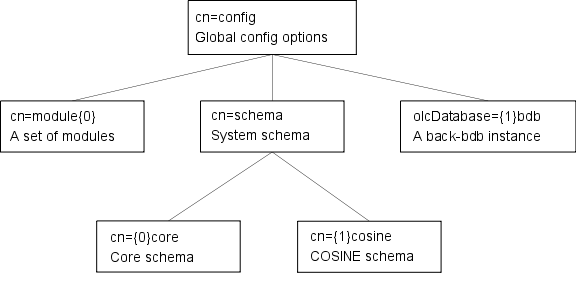
After reading this manual I ended up with a file that contains this:
root@helpDesk10000:~# cat base.ldif # example config file - global configuration entry dn: cn=config objectClass: olcGlobal cn: config # olcReferral: ldap://root.openldap.org
# internal schema
 dn: cn=schema,cn=config
 objectClass: olcSchemaConfig
 cn: schema

# include the core schema
 include: file:///usr/local/etc/openldap/schema/core.ldif

# global database parameters
 dn: olcDatabase=frontend,cn=config
 objectClass: olcDatabaseConfig
 olcDatabase: frontend
 olcAccess: to * by * read

# set a rootpw for the config database so we can bind.
 # deny access to everyone else.
 dn: olcDatabase=config,cn=config
 objectClass: olcDatabaseConfig
 olcDatabase: config
 olcRootPW: {SSHA}EQpw7T2x2Num+krwRjq/ZYczmRgaX1Km
 olcAccess: to * by * none

# BDB definition for example.com
 dn: olcDatabase=bdb,cn=config
 objectClass: olcDatabaseConfig
 objectClass: olcHdbConfig
 olcDatabase: hdb
 olcSuffix: dc=helpdesk,dc=co,dc=bw
 olcDbDirectory: /var/lib/ldap-database
 olcRootDN: cn=Manager,dc=helpdesk,dc=co,dc=bw
 olcRootPW: {SSHA}teY3/6WO7uoGrCmaDu9NKmvgn87WlCCw
 olcDbIndex: uid pres,eq
 olcDbIndex: cn,sn pres,eq,approx,sub
 olcDbIndex: objectClass eq
 olcAccess: to attrs=userPassword
 by self write
 by anonymous auth
 by dn.base="cn=Admin,dc=helpdesk,dc=co,dc=bw" write
 by * none
 olcAccess: to *
 by self write
 by dn.base="cn=Admin,dc=helpdesk,dc=co,dc=bw" write
 by * read
 root@helpDesk10000:~#
Nice, but now I needed to run the file and there is when the LDAP commands are helpful. you should-must read out there about them, but I am just going to put the one I used:
root@helpDesk10000:~# ldapadd -Y EXTERNAL -H ldapi:/// -vn -f base.ldif
 add objectClass:
 olcGlobal
 add cn:
 config
 !adding new entry "cn=config"

add objectClass:
 olcSchemaConfig
 add cn:
 schema
 !adding new entry "cn=schema,cn=config"

add objectClass:
 olcSchemaConfig
 add cn:
 core
 add olcAttributeTypes:
 ( 2.5.4.2 NAME 'knowledgeInformation' DESC 'RFC2256: knowledge information' EQUALITY caseIgnoreMatch SYNTAX 1.3.6.1.4.1.1466.115.121.1.15{32768} )
 ( 2.5.4.4 NAME

(...)

add olcDbDirectory:
 /var/lib/ldap-database
 add olcRootDN:
 cn=Manager,dc=helpdesk,dc=co,dc=bw
 add olcRootPW:
 {SSHA}teY3/6WO7uoGrCmaDu9NKmvgn87WlCCw
 add olcDbIndex:
 uid pres,eq
 cn,sn pres,eq,approx,sub
 objectClass eq
 add olcAccess:
 to attrs=userPassword by self write by anonymous auth by dn.base="cn=Admin,dc=helpdesk,dc=co,dc=bw" write by * none
 to * by self write by dn.base="cn=Admin,dc=helpdesk,dc=co,dc=bw" write by * read
 !adding new entry "olcDatabase=bdb,cn=config"
root@helpDesk10000:~#
The other thing pending is to start say to your LDAP to start using the slapd.d. Make sure to launch slapd(8) with the -F option to specify the configuration directory if you are not using the default directory path.
root@helpDesk10000:~# /path/to/slapd -F /path/to/slapd.d
If it worked for you that’s perfect, if it did not please check it again and otherwise post your problem, maybe I can help you.
Cheers